







Peru’s Broken System and the Generation Z Rebellion
September 30, 2025 Hour: 12:47 pm
🔗 Comparte este artículo
Peru under Dina Boluarte is burning with protests and discontent. With an approval rating barely scraping 4%, her government is sustained by a fragile political framework and increasing repression.
What began as an outburst of rejection against Peru’s economic system has become a widespread outcry against a decaying political system, driven primarily by a Generation Z that is no longer willing to remain silent.
The demonstrations are not just a reaction to the president’s unpopularity, but the accumulated response to authoritarian decisions that have exhausted the people’s patience.
The recent promulgation of an amnesty law protecting military and police personnel accused of human rights violations between 1980 and 2000 was the final straw.
This is compounded by contempt towards international bodies, as evidenced by the hasty withdrawal from the San José Pact, the legal shielding granted to Boluarte by the Constitutional Tribunal, which suspended all investigations against her until the conclusion of her term, and the corruption cases flooding her government.
Furthermore, traditional media outlets have chosen complicit silence, ignoring the massive demonstrations shaking Peru’s streets since September 20th. The message is clear: impunity and state violence are the tools of the current regime.
This article aims to explore in depth the reasons why the Peruvian people remain mobilized, as well as the connections between these protests and similar movements in other countries.
Generation Z Takes to the Streets: The Digital Cry of Native Youth
The main actor in this wave of mobilizations is Generation Z, young people born between 1995 and 2010, the first digital natives. They are not only protesting against corruption and repression; they are expressing a profound dissatisfaction with a system that denies them a future.
They demand the elimination of the Pension Fund Administrators (AFP), the reinstatement of prosecutor Delia Espinoza, and the closure of a Congress considered ineffective and disconnected from social demands.
Young people consider the AFP system a financial burden with few long-term benefits. Despite decades of contributions, the pensions that the system promises are very low, often insufficient to cover basic needs. Generation Z sees that their parents and grandparents cannot achieve a dignified retirement, which generates distrust.
As an alternative, the protesters demand a more equitable and solidarity-based pension system, where the State guarantees a dignified retirement for all, regardless of their employment situation.
The elimination of the AFPs represents a demand for a profound structural change in the country’s economic model.
Additionally, they accuse Boluarte’s government of ruling with authoritarianism, reflected in its contempt for international human rights institutions and its constant maneuvers to gain political immunity.
They demand justice for the victims of state violence and denounce police repression and state inaction in the face of insecurity.
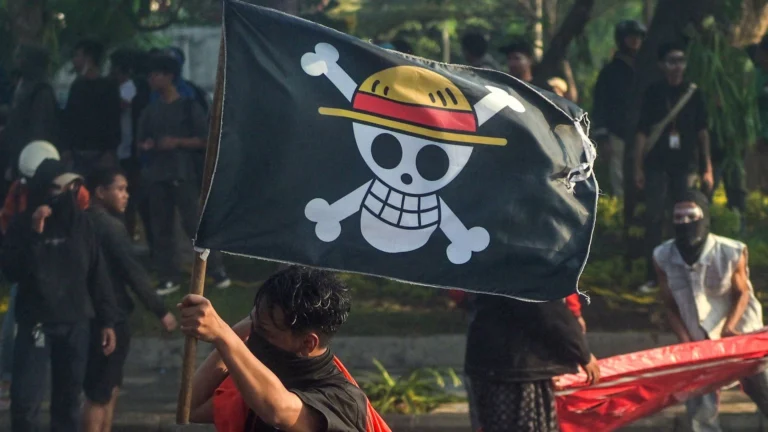
These protests have their own language and a particular aesthetic. Posters, chants, and slogans are intertwined with cultural symbols that resonate with the youth.
For example, the flag from the Japanese anime One Piece has become an emblem of resistance.
They are not only demanding political changes but are also forging a new identity of struggle, demonstrating that they are prepared to transform Peru for future generations.
This generation’s protest is an explosion of social and political discontent, combining rejection of an unpopular government with historical demands ignored for years, a combination that makes it unstoppable.
State Violence: The Human Cost of Repression
The outcry of the youth has been met with alarming brutality. Police repression has been indiscriminate, with excessive use of tear gas, rubber bullets, and beatings, leaving a significant toll of wounded and detained.
Videos and testimonies show aggression against peaceful protesters, including elderly adults, like the case of a grandfather wounded with a bloodied forehead after a police beating.
The violence is not limited to protesters; the National Association of Journalists has denounced systematic aggression against reporters covering the protests, incessant attempts at censorship, and the silencing of the independent press.
To date, at least 74 injuries have been recorded among protesters, journalists, and police. Organizations like the National Coordinator for Human Rights (CNDDHH) report dozens of people injured by disproportionate police action, highlighting emblematic cases: a 65-year-old man assaulted with a police baton, wounded volunteer medics, and journalists attacked while doing their jobs.
This violence is not an isolated incident, but part of a systematic pattern of disregard for human rights and freedom of expression. The Boluarte government has defied rulings from the Inter-American Court of Human Rights on 14 occasions, showing that impunity has become a state policy.
From Lima to the World: An Echo of Global Resistance
The protests in Peru are part of a global youth wave. From Santiago to Hong Kong and Nepal, Generation Z is emerging as a global political force.
These young people, connected by social media and a deep distrust in institutions, share similar demands: transparency, an end to corruption, social justice, and a dignified future.
Peru, also, is not isolated in Latin America. There is a common feeling with the demonstrations in Ecuador and Paraguay, where governments and congresses are also perceived as corrupt and ineffective.
In Peru, Ecuador, and Paraguay, the crisis of legitimacy of their leaders catalyzes popular discontent.
Although each country experiences particular triggers, the roots of the unrest are shared: demands for greater social justice, equitable distribution of resources, and urgent solutions to problems like insecurity and economic policies that harm the majorities.
The Peruvian case, due to its symbolism and the brutality of the repression, resonates in this global scenario.
The protesters in Lima see themselves reflected in young people from other continents, inspiring each other to demonstrate that the struggle for dignity and justice knows no borders.
Peru today is a mirror reflecting the tensions of our time and the emergence of a generation that refuses to inherit a country in ruins.
Reflections and Challenges for Peru’s Future
The protests shaking Peru under the government of Dina Boluarte are much more than a rejection of an unpopular administration. They are the legitimate expression of a people, especially its youth, demanding justice, transparency, and a profound change in political and social structures.
Generation Z is leading a mobilization that not only challenges state repression but also seeks to build a new national identity, with a message that transcends borders and connects with global movements.
Faced with increasing state violence and the political shielding of an increasingly authoritarian regime, a crisis of legitimacy is evident, questioning the very future of the country.
Will this new generation be able to break the chains of the past and build a more just and democratic Peru, or will it be drowned by the violence and impunity of the present?
Author: Silvana Solano
Source: TeleSur